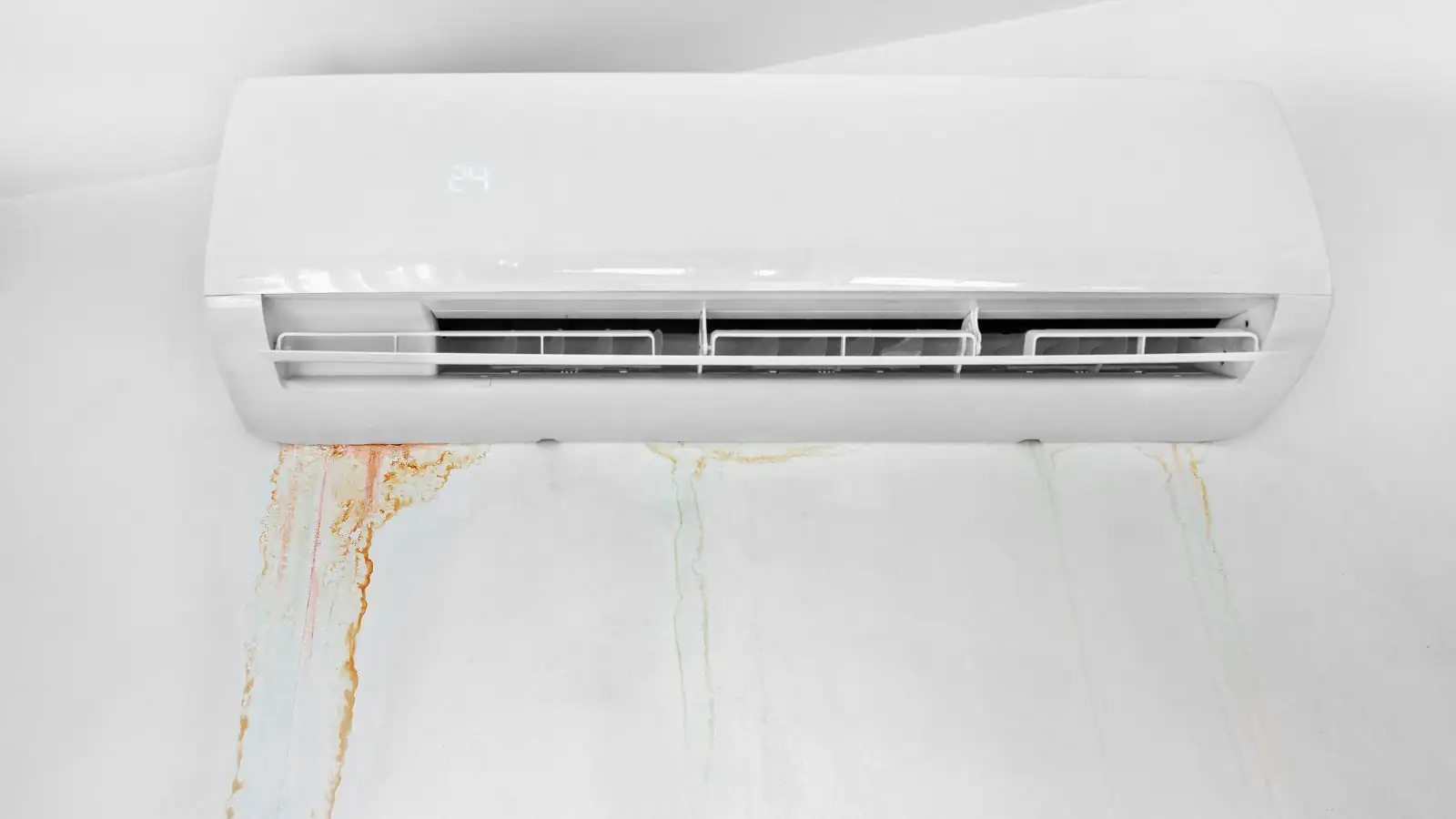
When an air handler sits in an attic or a furnace closet, its leaks do not stay put. Condensate drips into a pan, the pan overflows, and the water soaks insulation and the drywall ceiling below. In American Fork the first sign is often a brown ring on a hallway or bedroom ceiling.
Plumbing, water heater and appliance leaks make up a bigger share of water losses than AC leaks, but summer cooling does produce them. For the more common case, a failed supply line, see our burst pipe water damage page.
Why air conditioners leak
NOAA's 1991 to 2020 climate normals put the July average high at 95.2 F at Provo BYU, the nearest normals station to American Fork. The figure is for Provo, not American Fork itself, but it shows how hard cooling systems work in July.
A cooling system pulls moisture out of the air as it chills it. That water, called condensate, drips off the evaporator coil into a pan and leaves the house through a drain line. If the line clogs, the pan fills and overflows.
A frozen evaporator coil can cause trouble too. When the ice thaws, it can release more water than the pan was built to carry. Finding out why the coil froze is a job for an HVAC technician.
The Department of Energy's air conditioner guide mentions plugged condensate drains as a mold concern, which is one reason not to leave wet insulation in place.
Evaporative coolers are a different problem
The Department of Energy says evaporative coolers suit low-humidity climates and need a major cleaning each season. A leaking evaporative cooler is a supply-water problem, since it runs on a water line and a pan. We do not service the cooler, and we dry whatever it wet.
What the ceiling is telling you
| What you see | What it can mean |
|---|---|
| Brown stain on a ceiling below the attic | Condensate or pan overflow has soaked insulation and drywall. |
| Sagging or bubbled ceiling paint | Water is pooled above and is looking for a way out. |
| Water at the base of a furnace closet | Drain line or pan above it is overflowing. |
| Dripping at a vent or return grille | Moisture is running along ductwork. |
| Musty smell with the air on | Insulation or drywall is staying damp. |
Mold needs moisture to grow, so damp insulation left in place is what we watch for. Our mold remediation page explains what happens when drying comes too late.
Safety steps in the first hour
Turn off the AC
Switch the thermostat to off, then turn off the air handler's breaker. A running unit keeps making condensate.
Protect the room below
Move furniture and set out buckets. If the ceiling is bulging with water, keep people out from under it and call dispatch so the water can be released in a controlled way.
Watch for electrical hazards
Do not touch fixtures or outlets near a wet ceiling. Turn off that circuit at the panel if lights flicker.
Do not enter a wet attic
Wet insulation hides joists and wiring. Leave the attic alone until it is dry.
Call both trades
Call an HVAC technician for the unit and call us for the water.
Who does what
- An HVAC technician repairs the AC system, clears the drain and checks the coil.
- We do not repair air conditioning.
- We handle the wet ceiling, insulation and framing, and the drying afterward.
How we dry out an AC leak
- Locate the wet ceiling and insulation with a thermal camera and moisture meters.
- Remove soaked insulation and open the drywall where needed.
- Place air movers and dehumidifiers, and recheck readings until the cavity reads dry.
- Clean affected surfaces and remove materials that cannot be dried.
Water from a clogged condensate line is usually Category 1 or 2, depending on what the pan collected. ANSI/IICRC S500 is the reference for sorting categories. Drywall and paint repair afterward is scoped separately on water damage repair.
Ceiling stained under the air handler?
Turn the AC off, then call us so the wet insulation and drywall can be dried.
What changes the cost
| Factor | Why it matters |
|---|---|
| Time the leak ran | A slow drip over a summer wets more than one overflow. |
| Insulation and drywall affected | Soaked insulation is removed and drywall may be opened. |
| Access | An attic or tight closet makes the work slower. |
| Size of the wet area | More area means more equipment and drying time. |
| Rebuild | Replacing drywall and paint is separate from drying. |
Insurance and mistakes to avoid
Policies differ, so ask your insurer how they treat an AC leak. A sudden overflow and a long slow drip are often handled differently. Take photos, keep records and avoid permanent repairs before the insurer inspects.
- Running the AC while the pan is overflowing.
- Covering a stained ceiling with paint before it is dry.
- Leaving wet insulation up there for weeks.
We also work in Lehi and Alpine homes.
Questions about AC leaks
Yes. You can call at any hour, and we offer same-day response when available. Turn the AC off first, then call us.
No. An HVAC technician repairs the system and the drain. We dry the ceiling, insulation and framing the water reached.
It depends on how wet it is. We check with meters and a thermal camera, and remove drywall only when it cannot be dried.
It is a separate supply-water problem. We dry what it wet, and the cooler itself needs a separate repair.
As soon as you see it. Damp insulation and drywall give mold the moisture it needs, so quick drying matters.
If a ceiling is stained or an air handler closet is wet, call us and we will plan the drying. Call (385) 988-9410