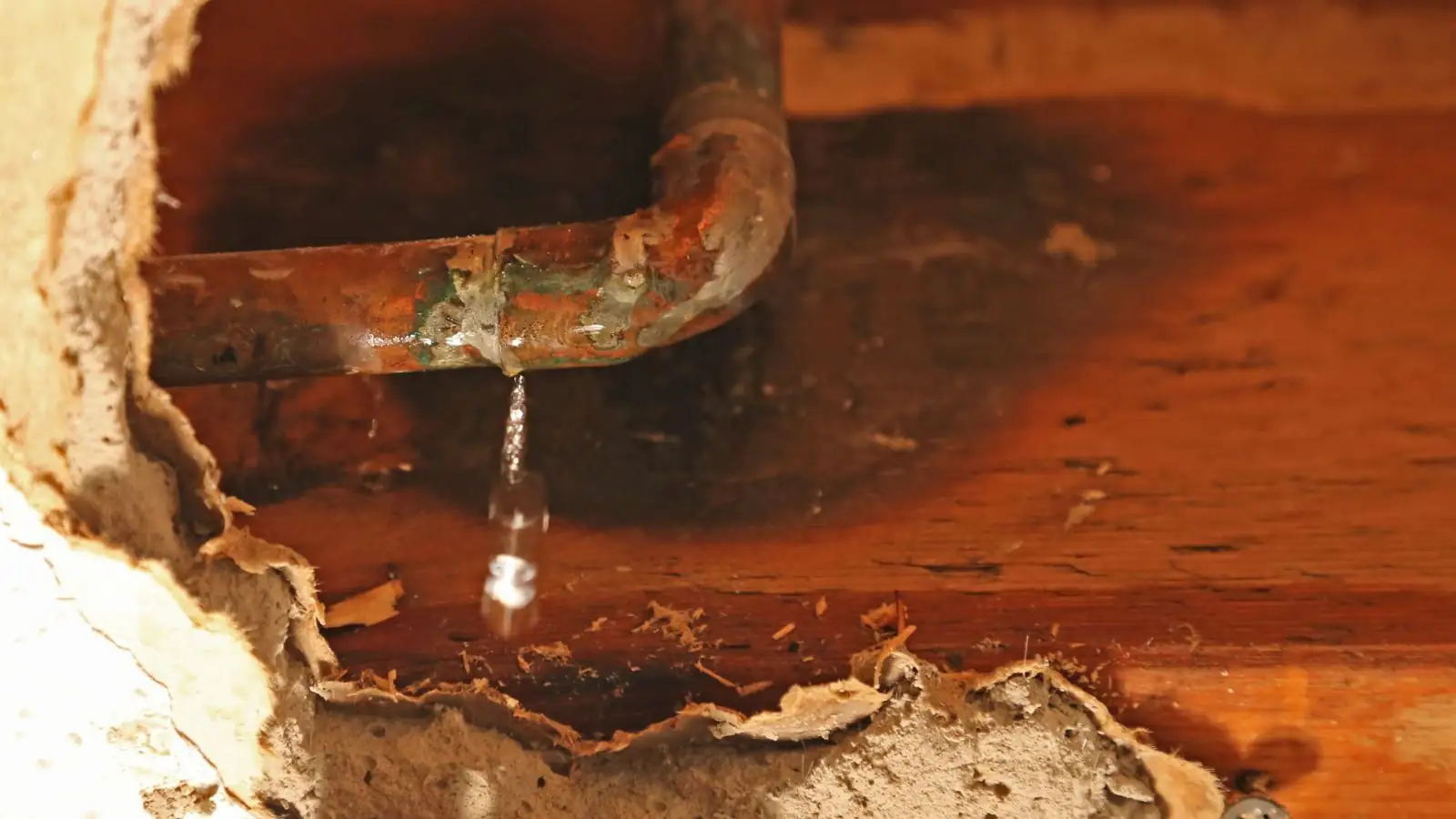
Pressurized water behaves differently from a slow drip. When a fitting lets go or a braided connector splits, water keeps coming until someone closes a valve. In American Fork that can happen in a newer subdivision with plastic lines or in an older house with copper pipe.
This page is about supply lines that fail at any time of year, and the cold-weather cause has its own page on frozen pipes.
How a pressurized line fails inside a house
The usual failure points are compression fittings, solder joints, washing machine and toilet connectors, ice maker lines and the short flexible lines under sinks. A pinhole in a copper run can spray into a wall cavity for days before a stain appears.
Water also travels. It follows framing, wiring holes and plumbing penetrations down through a floor and into the ceiling of the room below, and in a basement it soaks the bottom of finished walls. The city supplies culinary water from springs in American Fork Canyon and from deep wells, so the water starts clean, but it does not stay that way once it sits in carpet pad and drywall.
What you see and what it means
| What you notice | What it usually means |
|---|---|
| The sound of running water with every fixture off | A line is leaking somewhere. If the meter dial still moves, water is still flowing. |
| A ceiling stain that appears or grows overnight | Water is collecting above it. A pipe in the floor system or a wall is a likely source. |
| A warm or damp patch on a wall or floor | A hot water line may be leaking inside the cavity. |
| Bubbling paint or swollen baseboard | The wall has been wet for a while and the drywall is wicking. |
| A sudden drop in pressure at the faucets | A break may sit upstream of your fixtures. |
A pipe inside a wall can leak unseen for a long time, so a dry-looking surface is not proof that the cavity is dry. We check with a moisture meter and a thermal camera before deciding what to open.
First-hour safety steps
Close the main valve
Look where the line enters the house, often a basement wall, a utility room, a garage or the laundry area. Turn a round handle clockwise until it stops. A lever handle is closed when it sits crosswise to the pipe.
Open the lowest tap
With the main closed, open a basement sink or an outdoor spigot to drain pressure from the pipes so the run slows and stops.
Mind the electricity
If water reached outlets, light fixtures or the panel, leave the breaker alone unless you can reach it from dry floor. Never stand in water to touch electrical equipment, and stay out from under a ceiling that sags or bulges.
Check the street side
The meter box sits in the park strip and the city treats it as its own equipment. The city's standard drawing calls for a box 21 by 36 inches. If your valve will not turn or the break looks like it is on the street side, the city's water department lists an after-hours line on its water page.
Make the two calls
A plumber repairs the pipe. We handle extraction and drying, so call us while you wait for the plumber.
Photograph before moving things
Take photos or video of the wet areas and the failed part before cleanup, and keep the part if the plumber removes it.
Water still on the floor?
Call us and we will plan extraction and drying while your plumber handles the repair.
How we remove the water and dry the structure
We work from ANSI/IICRC S500, the standard for professional water damage restoration, as our reference. This is different from the general pump-out work described on emergency water removal, because a supply line failure often leaves water inside walls and under floors, not only on top of them.
- Extraction units pull standing water and water out of carpet and pad.
- Flood cuts open a wet wall along clean, straight lines just above the visible wet line, which keeps the later patch simple.
- Wet insulation and soaked drywall come out, since they hold water against framing.
- Air movers and dehumidifiers dry the cavity and the room together.
- Moisture meter and thermal camera readings go on a moisture map, and we repeat the readings until framing is dry.
The EPA says to dry water-damaged areas within 24 to 48 hours to prevent mold growth, so the first day matters. More on drying is under structural drying. The same steps apply to homes in Pleasant Grove and Lehi, which we also serve.
What changes the cost
| Factor | Why it matters |
|---|---|
| How long the water ran | Longer runs reach more rooms and soak deeper into framing. |
| Number of floors affected | Water that passes through a floor adds ceiling work below. |
| Materials involved | Carpet, hardwood and drywall dry or fail in different ways. |
| Days of drying equipment | Dense materials and cool, humid rooms take longer to dry. |
Where insurance fits
Policies differ on sudden failures compared with long-term leaks, and on damage the insurer decides came from neglect. The Utah Insurance Department tells policyholders to call their insurer as soon as possible, photograph the damage and hold off on permanent repairs until the property has been inspected. Ask your insurer what applies to your policy and keep every receipt and photo.
Mistakes that make a burst pipe worse
- Waiting for the adjuster before any drying starts.
- Patching drywall over a wall that has not been checked with a moisture meter.
- Leaving soaked carpet pad in place because the top of the carpet feels dry.
Questions about burst pipe water damage
We handle extraction and drying for burst supply lines in American Fork and the neighboring towns, with same-day response when available.
No. A plumber repairs or replaces the pipe. Our work is removing the water, opening wet walls where needed, drying the structure and documenting moisture readings.
Water that appears between your meter and the house is your side. A break on the street side of the meter is the city's. If you are not sure, close your own valve first and then call the city.
Only if you can reach the breaker from dry floor. If the panel area is wet, stay out and call an electrician.
If a supply line has failed in your house, call us and we will talk through the water on the floor and in the walls. Call (385) 988-9410