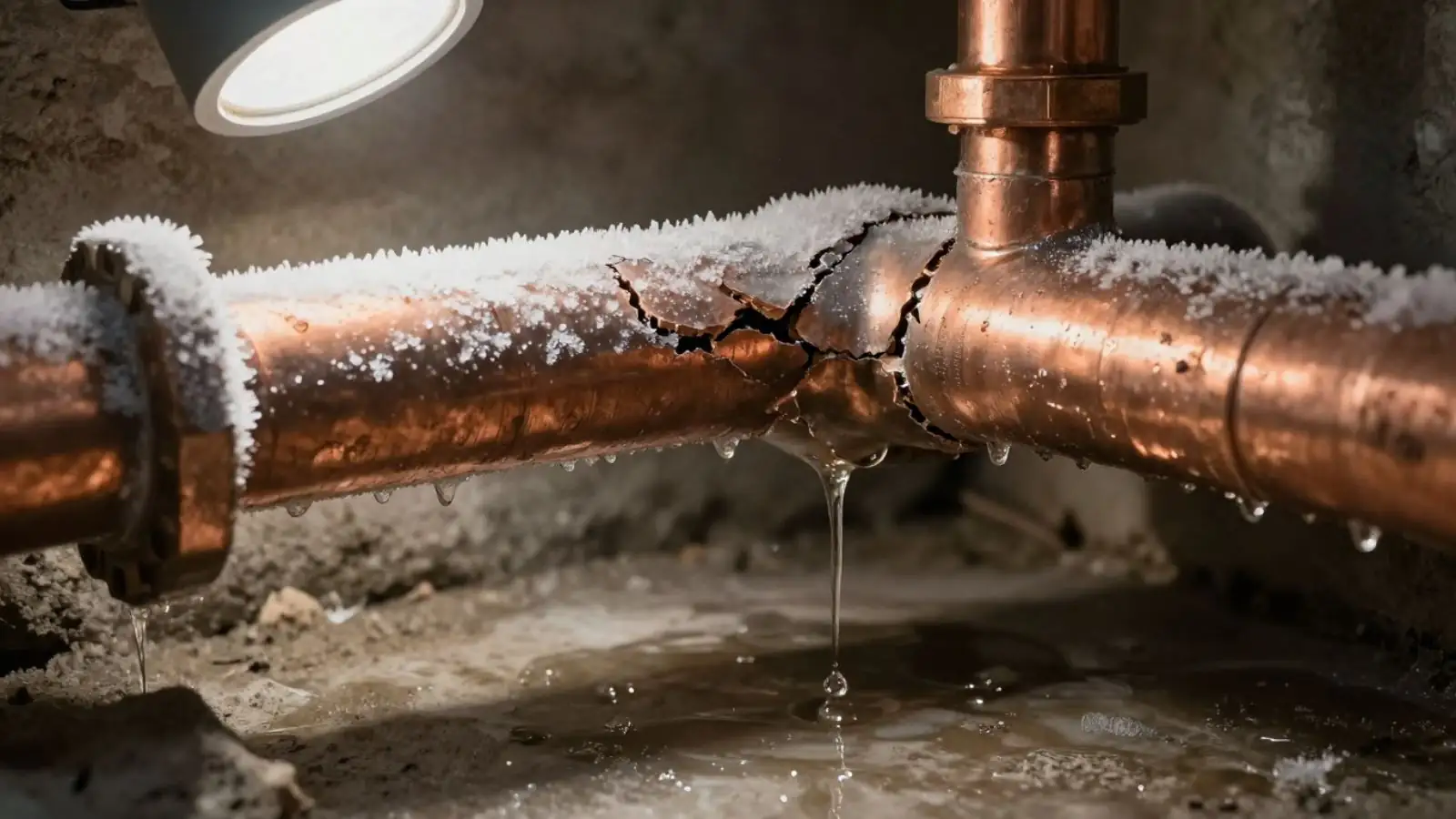
Water expands as it freezes, and a plug of ice in a pipe pushes pressure toward the weak spot, which is usually a fitting or a thin spot in the pipe. The crack can sit quietly while the ice holds. The leak begins when temperatures rise and the ice thaws, often while you are at work or asleep.
Why American Fork pipes freeze
The nearest station with NOAA 1991 to 2020 climate normals is Pleasant Grove, next to American Fork. It shows a January average low of 23.8 F and about 123 days per year when the low reaches 32 F or colder. Those are not rare cold snaps. They are an ordinary part of the year.
The same normals give a 50 percent probability that the last spring freeze arrives by April 17, and a 50 percent probability that the first fall freeze arrives by October 25. These are probabilities from the normals, not forecasts, and some years freeze later or earlier.
The city requires its service laterals to be buried at least 48 inches deep unless the city engineer approves otherwise. That is a standard for the line in the ground. The pipes inside your house get no such cover.
- Pipes in exterior walls, especially on the north side
- Garages and unheated mud rooms
- Crawl spaces with open vents or missing insulation
- Outdoor spigots and the irrigation lines that feed them
- Rooms over a garage, or any space that is closed off and left cold
What you see and what it means
| What you notice | What it usually means |
|---|---|
| A faucet gives only a trickle or nothing | Ice is blocking the line. The pipe may or may not have split yet. |
| Frost on a pipe or a bulge in it | Ice is forming. Treat the pipe as damaged. |
| Water appearing after a warm day | The ice melted and a crack is now open. |
| A ceiling stain or wet wall near an exterior corner | The split is probably inside the cavity. Check the meter. |
| Running water with every fixture off | A split line is leaking. Close the main right away. |
Because damage shows up at the thaw, a wall that felt fine in the morning can be soaked by evening. This is the main difference from a failure at any other time, which is covered on burst pipe water damage.
First-hour safety steps
Close the main shutoff
Find the valve where the line enters the house, in a basement, utility room or garage. Turn a round handle clockwise, or turn a lever crosswise to the pipe. Do this first, whether or not water is visible.
If the pipe is frozen but not split
Open the tap nearest the frozen section so water can move as the ice melts. Warm the pipe gently with a hair dryer or by raising the room temperature. Never use a flame, a torch or a heat gun.
If the pipe has already split
Leave the main closed, open a low faucet to drain the lines and expect water at the damaged spot. Do not restore water until a plumber has repaired it.
Handle electricity carefully
Do not touch switches, outlets or the panel while standing on a wet floor. Stay out from under any ceiling that sags.
Call the right people
A plumber thaws and repairs. We do not repair or thaw plumbing. Call us for extraction and drying, and photograph the damage before you clean up.
Pipe thawed and the floor is wet?
Call us and we will extract the water and check the walls for hidden moisture.
How we find hidden water and dry it
We use ANSI/IICRC S500, the standard for professional water damage restoration, as our reference for how to dry a structure. After a thaw we start with a moisture meter and thermal camera sweep, because water from a split pipe often runs down inside exterior walls and into the ceiling below.
- Extraction units remove standing water and water in carpet and pad.
- Wet insulation comes out, and drywall is cut open along clean lines where readings stay high.
- Air movers and dehumidifiers dry the wall cavity and the room together.
- A moisture map records readings so you can see the framing reach dry levels.
- Containment keeps dust from moving into dry rooms when walls are opened.
The EPA says to dry water-damaged areas within 24 to 48 hours to prevent mold growth, so a thaw leak found late is a reason to act fast. Wider flooding is covered on emergency water removal, and the same work applies in Lindon and Alpine, where hillside homes see similar cold.
How to prevent frozen pipes
The city advises closing the irrigation shutoff valve and blowing out sprinkler lines each fall, because a freeze can crack a line that still holds water. Do that before the first fall freeze and you remove a common cause.
- Let a faucet drip on very cold nights, especially on exterior walls.
- Open cabinet doors under sinks on outside walls.
- Keep the heat on, even in a room you do not use.
- Disconnect garden hoses and close outdoor spigot valves.
- Learn where your main shutoff is before you need it.
- Before a trip, set the heat above freezing and have someone check the house.
Cost factors and insurance
| Factor | Why it matters |
|---|---|
| How long water ran after the thaw | Longer runs soak more rooms and framing. |
| Pipes inside walls and ceilings | Hidden leaks mean cuts and more drying. |
| Floors and finishes | Hardwood, carpet and drywall react differently. |
| Whether the home was occupied | An empty house can run water for days. |
The Utah Insurance Department says frozen pipes may not be covered if the damage is due to negligence. Policies differ, so keep records of heat settings and repairs, photograph the damage and ask your insurer what applies. We do not decide coverage.
Questions about frozen pipe water damage
We handle extraction and drying after frozen pipes thaw and leak in American Fork and nearby towns, with same-day response when available. We do not thaw or repair the plumbing.
In the Pleasant Grove normals, the last spring freeze has a 50 percent probability of coming by April 17, and the first fall freeze has a 50 percent probability by October 25.
No. Open flames and high heat are a fire risk and can damage the pipe. Gentle warmth and a plumber are safer.
Yes. A hairline crack can open when ice melts, and the leak can run inside a wall.
Yes, each fall, before the first hard freeze. A line left full of water can crack, and the crack shows itself when the system is filled again.
If a thaw has left water in your walls or floors, call us and we will start with where it went. Call (385) 988-9410