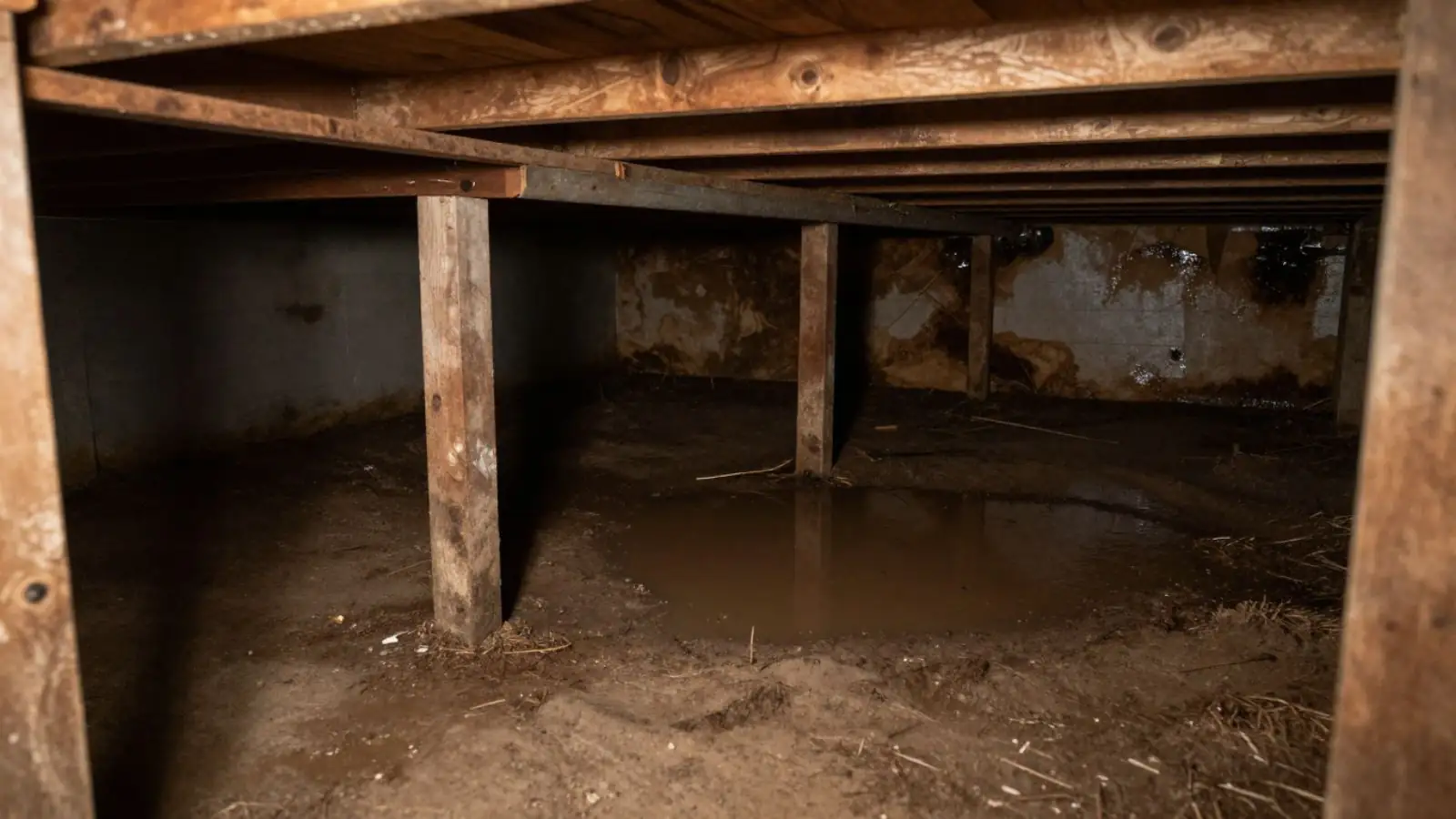
A crawl space is the shallow gap between the ground and the first floor of a house. Water gets in from a leaking supply or drain line, from irrigation or runoff that finds a vent or foundation gap, or from groundwater rising close to the surface. This page covers homes with crawl spaces. Water in a basement is a different job, so go to emergency water removal or flood damage restoration.
How water ends up under the floor
A pinhole in a pipe or a failed drain fitting can drip for a long time because nobody looks down there. Sprinkler heads aimed at the foundation and downspouts that empty beside the wall can push water through vents or small cracks.
Groundwater is the harder case. The Utah Geological Survey says shallow groundwater can occur anywhere in Utah, and it is more likely in low-lying valleys and near waterways. The Utah state flood program adds that FEMA flood maps do not reflect groundwater flooding, so a home outside a mapped floodplain can still get wet from below.
What you notice upstairs and what it means
- Cold or soft spots in the floor: the subfloor may be absorbing moisture from below.
- A musty smell near floor vents: damp insulation or wood under the house.
- Higher water bills with no visible leak: a supply line may be running unseen.
- Cupped or buckled flooring: moisture is moving through the subfloor.
- Pests or white fuzzy growth on joists: the space has stayed damp for a while.
None of these proves a crawl space leak by itself. They are reasons to look, or to have someone look, before wood stays wet. Damp lumber is the condition mold needs, so the goal is to dry it quickly.
Safety before anyone goes under the house
Check these first
- Find the main water shutoff and close it if you suspect a supply line.
- Do not enter if the water is deep, because wiring and ducts may be low and live.
- Do not enter if there is a sewage smell. That water is contaminated and our sewage backup cleanup page applies.
- Treat wet soil as unstable and never go in alone.
- Turn off power to any circuit that serves the crawl space if the panel is dry and reachable.
A crawl space is a confined space with little air and little room to get out. A flashlight look from the access hatch is safer than crawling in, and it often tells you enough to make the call.
Water under the floor?
Call now and we will talk through what you can see from the hatch.
How we dry a crawl space
Access and assessment
We check the hatch, measure how deep the water is and look for the source with a flashlight and moisture meter.
Extract
Pumps and extraction units remove standing water, and we discharge it away from the foundation.
Remove soaked material
Wet insulation and loose debris come out, since insulation holds water against the wood.
Dry
Air movers and dehumidifiers dry the joists and subfloor, and we adjust equipment as readings change.
Verify
Moisture meter readings and a thermal camera confirm the framing has returned to a normal level.
The approach follows ANSI/IICRC S500, the reference standard for professional water damage restoration. For wet framing on its own, see structural drying.
We do not install drainage, sump systems or vapor barriers, and we do not do foundation work. Ask a licensed plumber about leaking lines and a drainage or waterproofing contractor about keeping water out.
What changes the cost
| Factor | Why it matters |
|---|---|
| Depth of water | Deeper water takes longer to pump and may need more equipment. |
| Height of the space | Low clearance slows work and limits what can be set up. |
| Insulation and debris | More wet material means more removal and disposal. |
| Size of the area | A larger footprint needs more air movers and drying time. |
| Source of the water | A fixed leak dries faster than a recurring seep. |
Insurance and groundwater
Coverage depends on the cause. The Utah Geological Survey says standard homeowners policies and the National Flood Insurance Program do not cover groundwater flooding. A sudden pipe leak is a different situation from seepage, and policies differ.
Ask your insurer what applies, take photos of the space and keep every receipt. Do not wait on an adjuster to begin drying, but tell them what you plan to do.
Mistakes to avoid
- Closing the vents and hoping the space dries on its own.
- Leaving wet insulation in place because it looks fine from above.
- Entering with a pump and an extension cord in standing water.
- Guessing at the source. Find it before drying, or the water returns.
We also serve Lehi and Lindon, where crawl spaces and shallow water tables can show up in the same way.
Questions about crawl space water
Yes. The dispatch line is answered 24/7, and same-day response is offered when available. Call as soon as you suspect water, since wet joists and subfloor are easier to dry early.
A fan alone rarely dries framing under a house. Moisture needs to be pulled out with dehumidifiers and moved with air movers, and the readings should confirm it.
Not if water is deep, if you smell sewage or if you cannot see the wiring. A look from the access hatch is the safer first step.
No. A plumber handles pipe repairs, and a drainage or waterproofing contractor handles sumps and vapor barriers. We remove the water and dry the structure.
The Utah Geological Survey says standard homeowners policies and the National Flood Insurance Program do not cover groundwater flooding. Ask your insurer about your own policy.
We take moisture meter readings of the joists and subfloor and check with a thermal camera before removing equipment.
Wet wood under the floor does not get better on its own. Call and describe what you see. Call (385) 988-9410