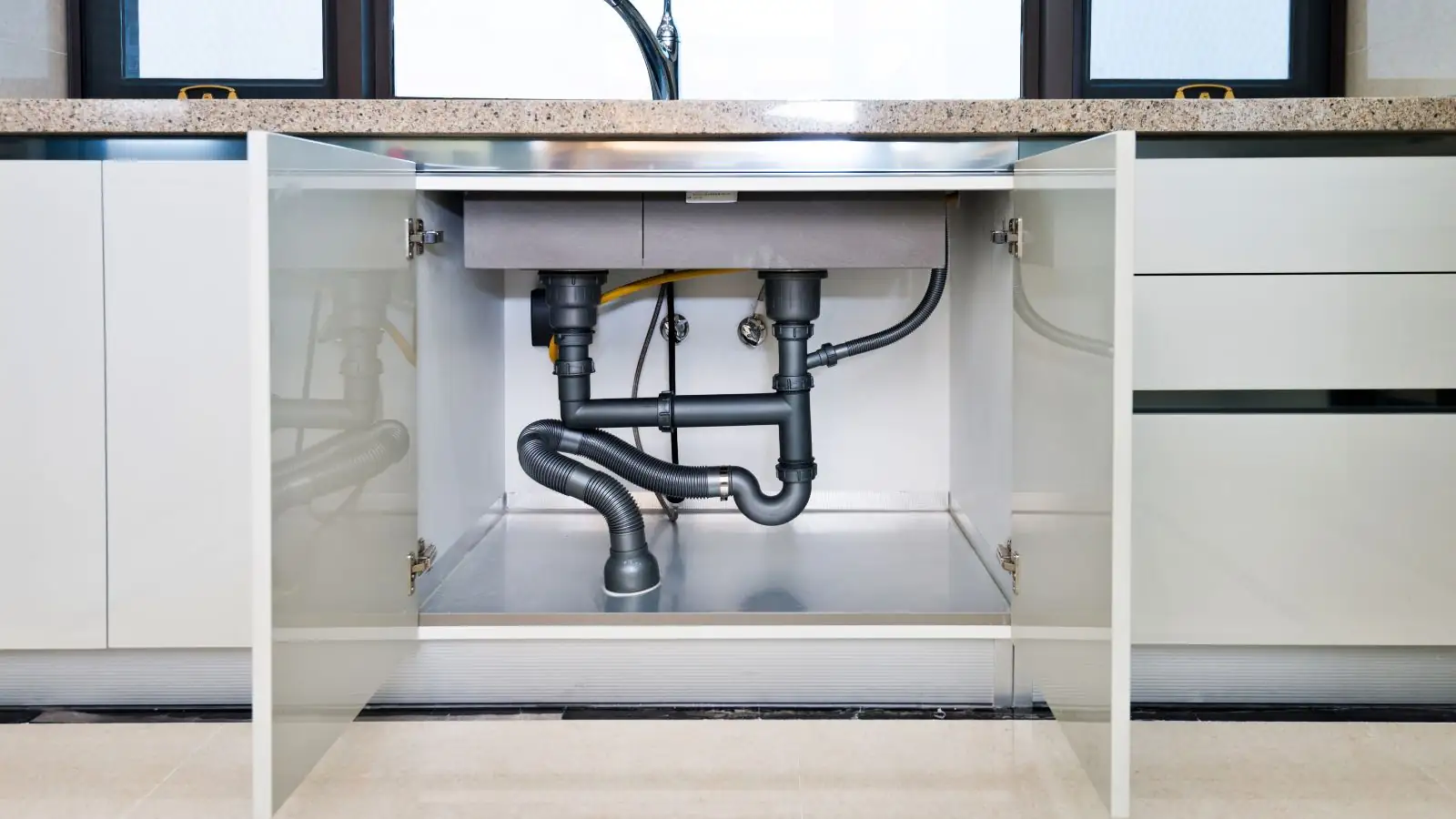
A kitchen water loss can begin small: a drip at a sink supply line, a loose dishwasher drain hose, a slow weep at the fitting behind a fridge. The trouble is where the water goes next. It follows the pipe chase into the base cabinets, slips under the toe-kick and spreads across the subfloor. With a winter furnace running, the surface can look fine in a day while the cabinet bottom stays wet.
What a wet kitchen is made of, and why it matters
Many base cabinet boxes are particleboard or MDF with a thin laminate skin. Once wet, those boards swell at the edges, the skin lifts and they rarely return to shape. Laminate countertops can open at the seams near the sink rim.
Flooring is the other travel route. Vinyl plank, tile or hardwood often runs straight from the kitchen into the dining room or hall, so water under the floor can show up several feet from the sink. Over a finished basement, the same water can stain the ceiling below. For leaks that start at a washer, fridge or laundry hookup, see our page on appliance leak cleanup.
We do not have local figures on how often kitchen supply lines fail in American Fork, so this page sticks to how water behaves in cabinets and floors rather than claiming a local pattern.
What you see and what it usually means
- A musty smell when you open the sink cabinet: the cabinet floor or the wall behind it is still damp.
- Laminate countertop edges lifting near the sink or dishwasher: moisture has reached the substrate under the surface.
- Flooring that cups, lifts or feels soft near the dishwasher: water is in the subfloor, not only on top.
- A brown ring or sag in the ceiling below: water has travelled through the floor system.
Dry surface, wet cavity
A cabinet that feels dry on the front can hold water in the toe-kick void, the cabinet bottom and the floor layers beneath it. A moisture meter and a thermal camera show what a hand cannot.
First-hour safety steps for a kitchen leak
Close the fixture stop valve
Under the sink, turn the small oval handle on the leaking supply line clockwise. If it is stuck or the leak is at the dishwasher or ice-maker line, close the main shutoff where the water line enters the house.
Keep power away from the wet zone
If water reached an outlet, the dishwasher plug or the disposal switch, turn off that breaker before you touch anything. Do not stand in standing water to reach the panel.
Move belongings and soak up pooled water
Empty the cabinet, lift items off the floor and towel up what you can. Do not run a household vacuum on wet floors.
Photograph before cleanup
Take photos and video of the cabinet, the floor and any ceiling stain. The Utah Insurance Department says to photograph the damage and to call your insurer as soon as possible.
Call for drying help
Call (385) 988-9410 and tell us what the water touched and how long it sat.
How we dry a kitchen in place
We start with moisture mapping. A pinless meter scans the flooring, cabinet faces and wall base, and a thermal camera shows cooler wet patches behind panels. Readings on unaffected material in the home set the goal, in line with the reference standard for professional water damage restoration, ANSI/IICRC S500.
Where possible we dry cavities in place instead of tearing out cabinets. A technician removes the toe-kick or drills small holes in it, then blows dry air into the void with an air mover while a dehumidifier pulls moisture out of the room. When the cabinets have to come off, we pull them in sections and set drying mats or air movers under the floor layers so the subfloor can dry from both sides.
Wet cabinets or a damp kitchen floor?
Tell us what the water touched and we will say what to move, what to leave and what we would measure first.
What changes the cost of kitchen drying
| Factor | Why it matters |
|---|---|
| How long the water sat | Longer wetting moves water from the surface into the cabinet bottom and subfloor. |
| Cabinet and floor material | Plywood and solid wood often dry in place. Particleboard and MDF often must be replaced. |
| Spread to other rooms or below | A ceiling stain below or flooring that continues into the next room adds drying area. |
| Equipment days | Air movers and dehumidifiers run until readings reach the goal, not for a fixed number of days. |
Insurance fit for kitchen leaks
Policies differ on sudden leaks versus long-term seepage, and only your insurer can say how your loss is treated. The Utah Insurance Department tells homeowners to call promptly, photograph the damage and hold off on permanent repairs until the insurer has inspected. Keep receipts and notes on what was removed.
Mistakes that make kitchen damage worse
- Waiting to see if it dries by itself. The EPA says water-damaged materials should be dried within 24 to 48 hours to prevent mold growth.
- Closing the toe-kick over wet cavities or sealing the cabinet with fresh caulk and paint.
- Assuming the leak is on the city side. The city supplies culinary water from springs in American Fork Canyon and five deep wells, but a drip under your sink is on your side of the meter.
We do not repair plumbing. A plumber fixes the line or valve, and our part is water removal, drying and putting finishes back. We also work in Pleasant Grove and Lehi, and the wider process is on our water damage repair page.
Questions about kitchen water damage
Yes. Kitchen water moves into cabinets and floors quickly, so we offer same-day response when available. Shut the fixture valve first if you can, then call.
Often yes if the boxes are solid wood or plywood and drying starts quickly. Particleboard or MDF that has swollen or delaminated usually has to be replaced, and a moisture reading shows which case you have.
Not always. Floating and some glued floors can be dried with mats and air movers if readings come down. Flooring that has cupped, softened or stayed wet for several days is more likely to need replacement.
Policies differ, so ask your insurer. Photograph the damage and keep receipts.
Moisture readings in cabinets, subfloor and walls match those in dry reference materials, and we log them each visit. A surface that feels dry is not the signal.
Water under the sink or in the cabinets? Call and we will walk you through the next step. Call (385) 988-9410